
Just Energy Transition “pace accelerates enormously”
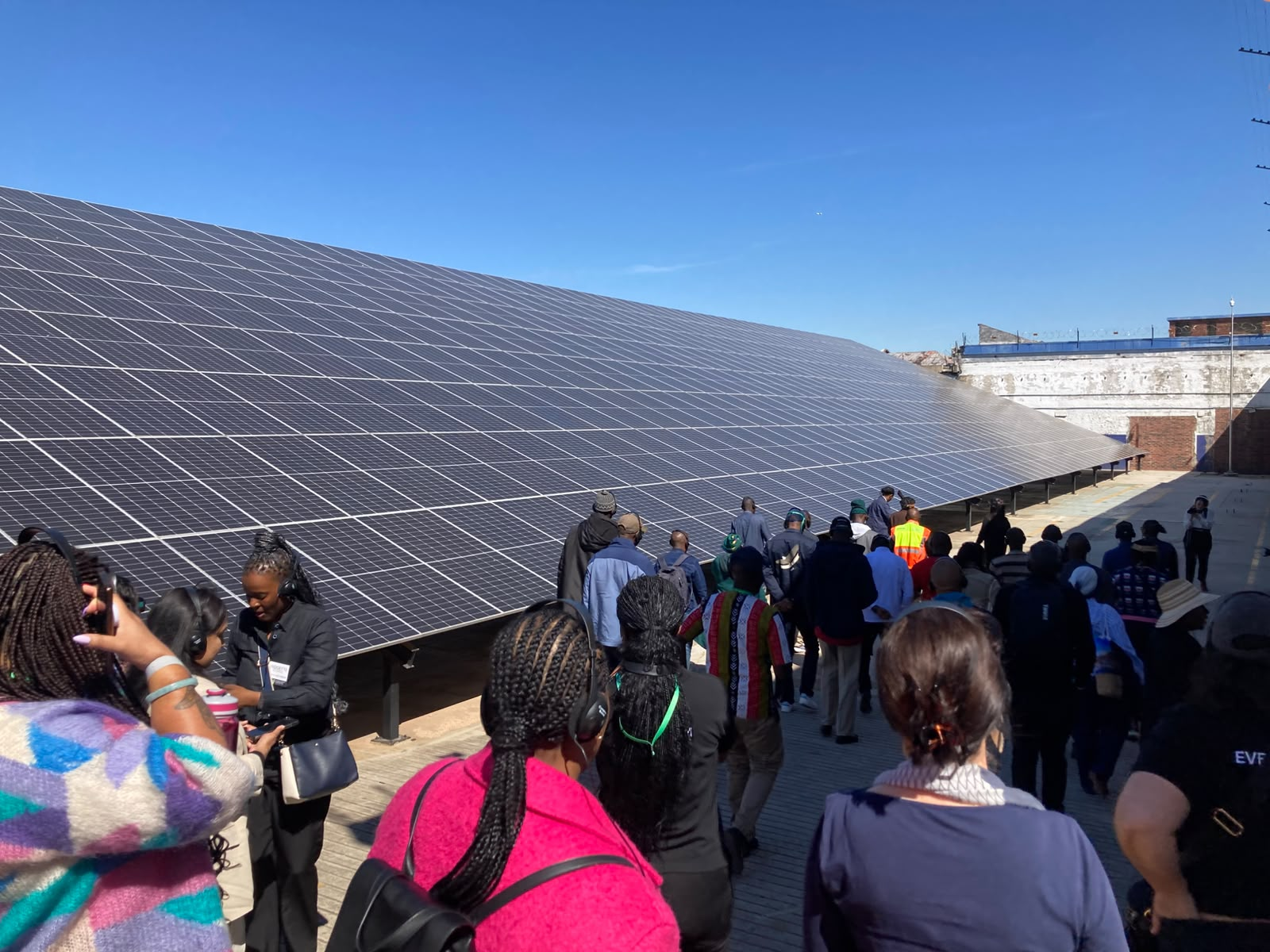
A solar array in a microgrid in Alexandra, Johannesburg
South Africa’s Just Energy Transition (JET) has been criticised for being slow, underfunded and behind schedule – and there’s evidence for all three. But a senior figure driving it has said the the momentum is real and accelerating.
That message came at a learning exchange that FFSA attended in Johannesburg last week, at the invitation of one of our funders, New Economy Hub (NEH). South African and Senegalese JET leaders had gathered to learn from one another, with some media and civil society partners.
The event ran under Chatham House rules, so the speakers can’t be named. But what they shared can be reported, and much of it has not been heard publicly before.
The JET is, at heart, a vast government-backed plan to move South Africa away from coal and toward renewable energy in a way that leaves no one behind – especially not the coal-dependent communities of Mpumalanga.
It includes the greening of South Africa’s electricity sources, new-energy vehicles, skills for those affected by the transition, and a “green hydrogen” economy, all aimed at helping South Africa to honour its climate pledges (Nationally Determined Contributions) to the secretariat of the United Nations Framework Convention on Climate Change.
FFSA supports the JET wholeheartedly. However, we remain unconvinced that a “green hydrogen” economy is feasible at scale, and we must note that the transition is not yet ambitious or fast enough. South Africa’s NDCs have been rated “insufficient” by the Climate Action Tracker, an independent scientific project that measures country climate action against the globally agreed Paris Agreement goal.
The South Africa-Senegal gathering was convened by the NEH, the African Climate Foundation, and CRADESC (the Dakar-based Research and Action Centre for Economic, Social and Cultural Rights). According to the senior figure we heard from, the JET is “well under way, its pace picking up enormously,” although it is is “not an easy or linear process.”
One obstacle the JET is tackling is that many community and municipal projects simply aren’t funding ready. It emerged that funds were being spent on technical assistance, research and capacity building rather than on projects “on the ground”.
To fix this, the JET has built a “match-making mechanism”: investment-ready projects are listed on a public register, then matched with organisations holding grant capital.
It started with international funders and is now widening the net to philanthropies and the private sector. The programme is on track to match 14 projects by the end of 2026.
The transition itself has been under way for a decade, although though the Just Energy Transition Partnership (JETP) – the structure that drives it, reporting to project management in the President’s office – was only established in 2022.
The JETP has secured $14.3 billion in pledges, a large increase on the $8.5 billion announced at COP26, yet still well short of the $98 billion the investment plan says is needed.
Notably, the bulk of that $98 billion is expected to be funded domestically – by the private sector and government – rather than by international donors.
“It’s not just an energy transition,” the leader said. “It’s a social transition that shapes all other aspirations.” She was referring to the enormous socio-economic and health benefits of cleaner, cheaper electricity than the ageing coal fleet can provide.
Finally, an important point: the JET is separate from the country’s nuclear and gas ambitions, which are part of South Africa’s broader energy plans and which we and our fellow human-rights and climate non-profits oppose.
Our takeaway is that the JET is an extraordinary effort, led by people who are extremely dedicated, committed and experienced. Yet it has a long way to go, and its success is not guaranteed.
Civil society must play the crucial role of championing the transition while holding it to account on its ambition, its speed and its delivery of community empowerment.
ENDS
