
Despite the positive trends in the story next to this one, there is room for concern over our fossil-fuelled world. The gas lobby in South Africa, as elsewhere, is on overdrive in attempts to secure its future profits, regardless of the consequences for people and planet.
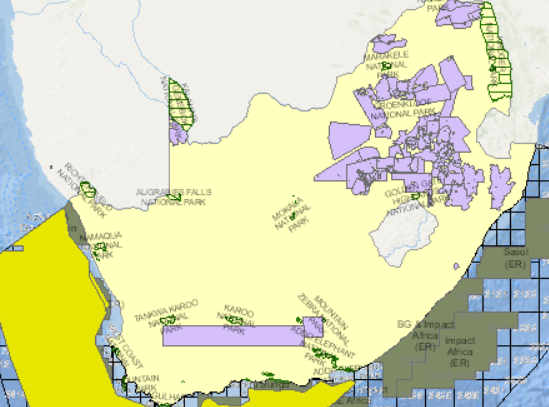
Solar industry insiders have alerted Fossil Free SA to the fact that vast tracts of land in Mpumalanga – which should be the epicentre of South Africa’s Just Energy Transition to renewables, as it is hosts most of our coal plants – have instead been allocated for gas and oil exploration.
Most if not all of these exploration rights were allocated in the past two years by the Department of Mineral and Petroleum Resources.
A better-known fact is that over 90% of South Africa’s coastline being allocated for oil and gas exploration, as the map above reveals. However, much of this oil and gas is extremely difficult and expensive to extract, given our wild seas and the deep seabeds in the allocated areas.
In another development, Minister of Petroleum and Energy Resources Gwede Mantashe and fossil fuel lobbyists are promoting the prospect of special “oil and gas courts” to stop communities and activists from taking legal action against fossil fuel projects.
In South Africa, the draft Gas Master Plan, published in April 2024, and the Gas Bill, introduced in March 2026, both push gas as a “transition fuel.” But expanding gas infrastructure risks locking the country into more fossil-fuel dependence in the long term, and rising methane emissions.
Why all the fuss about gas? Is it not a “transition fuel”, as governments and fossil fuel lobbyists claim? Not at all.
”Natural gas”, better known as “fossil gas”, is a fossil fuel whose primary constituent is the powerful greenhouse gas methane. During the first 20 years after it is emitted, methane is about 81 times more potent at trapping heat, and therefore causing global warming, than carbon dioxide.
Methane leaks occur throughout the gas supply chain: during drilling and extraction, in processing plants, in pipelines and storage facilities, and during liquefication and shipping of LNG (liquid natural gas).
These leaks can significantly erode − or eliminate − the apparent climate advantage of gas over coal.
With our government and others pushing hard for new gas projects, the need for climate activism — and for supporting a real Just Energy Transition — has never been stronger.
